
Discover how to manage cloud cost effectively by identifying hidden drains that impact your budget.

November 25, 2026
Nearly every unmanaged cloud account leaks money through the same five hidden drains, regardless of provider. Knowing where to look lets you cut costs without touching performance or your team.
It's a common assumption that keeping cloud spending in check just means watching the big-ticket items. In practice, the real damage comes from small, recurring charges that nobody is watching at all.
Even a lean team running smooth systems can bleed budget this way, because the waste is quiet rather than dramatic. Cloud pricing compounds the problem: services are billed separately, usage patterns shift constantly, and without a clear review process, it's easy to miss exactly where the money is leaking.
Here's the insight that cuts through the complexity: most unmanaged cloud accounts waste money in the same handful of ways, regardless of which provider they use. Businesses that learn to spot these patterns can usually recover that spend without touching performance or headcount, since the fix is about attention rather than cuts.
That attention has a measurable payoff. A study found that SMBs using cloud technology see 21% higher profits, but only when their spending is managed well. In other words, the gap between growth and waste usually comes down to whether anyone is looking for it.

Cloud pricing is built for flexibility, and that same flexibility is exactly what makes waste so easy to miss. AWS, Azure, and Google Cloud each offer hundreds of services, and each service carries its own pricing structure.
That complexity shows up fastest when teams scale. Spinning up new resources for a project is simple, but scaling back down afterward is the step that gets forgotten, so unused or underused resources keep running and quietly inflate the bill. This is especially common where there's no formal process for reviewing cloud usage on a schedule.
Billing structure adds a second layer to the problem: storage, compute, and network traffic are metered separately, so optimizing one doesn't mean the others are covered. A team might trim compute costs successfully while old backups keep piling up in storage, which means paying month after month for data nobody needs anymore.
Nashville businesses run into this constantly as their cloud environments scale up. Without regular cost analysis built into the routine, waste simply becomes part of the monthly bill.
That same pattern - growth outpacing oversight - tends to produce the same handful of waste sources, no matter the provider or the industry. Recognizing them is what makes it possible to target waste directly, without touching the systems or the team behind them.
Virtual machines, storage volumes, and IP addresses often outlive the projects or migrations that created them. Nobody removes them manually, so they keep generating charges indefinitely.
Choosing a larger compute instance "just to be safe" is a common instinct, but it means paying for capacity that sits unused every hour of every day. The safety margin becomes a permanent cost rather than a one-time precaution.
Reserved instances and savings plans lock in lower rates, but only if actual usage keeps matching the reservation. When it drifts, the business ends up paying for capacity it never actually uses.
Backups and snapshots matter, which is exactly why they tend to accumulate unchecked. Without regular deletion of outdated copies, storage costs keep accruing for data that's already obsolete.
Development and test environments frequently keep running outside business hours or after a project wraps. Charges continue to build even though no one is using the systems at all.
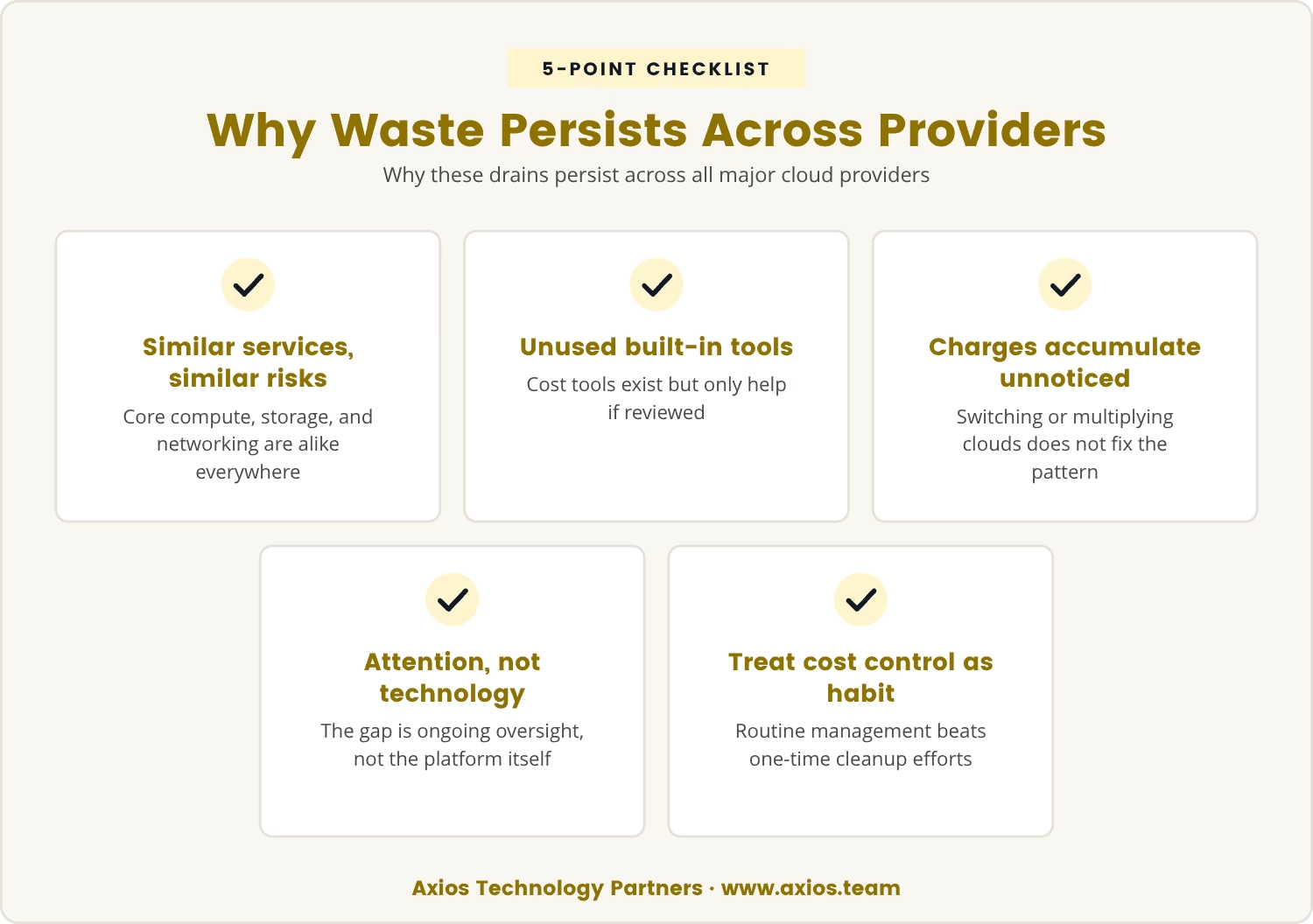
The same waste patterns show up on AWS, Azure, and Google Cloud alike, which makes sense once you consider why: the core services and pricing models across providers are fundamentally similar. Each offers flexible compute, storage, and networking, and each requires active management to keep costs from creeping up unnoticed.
Built-in cost management tools exist on every platform, but they only work if someone actually reviews them. Skip that step and small charges accumulate invisibly over time, which explains why even businesses that switch providers or run multiple clouds run into the exact same issues again.
The technology isn't the weak point - the lack of ongoing attention is. Cloud investments perform best when cost control is treated as a routine habit, not a one-time cleanup project.
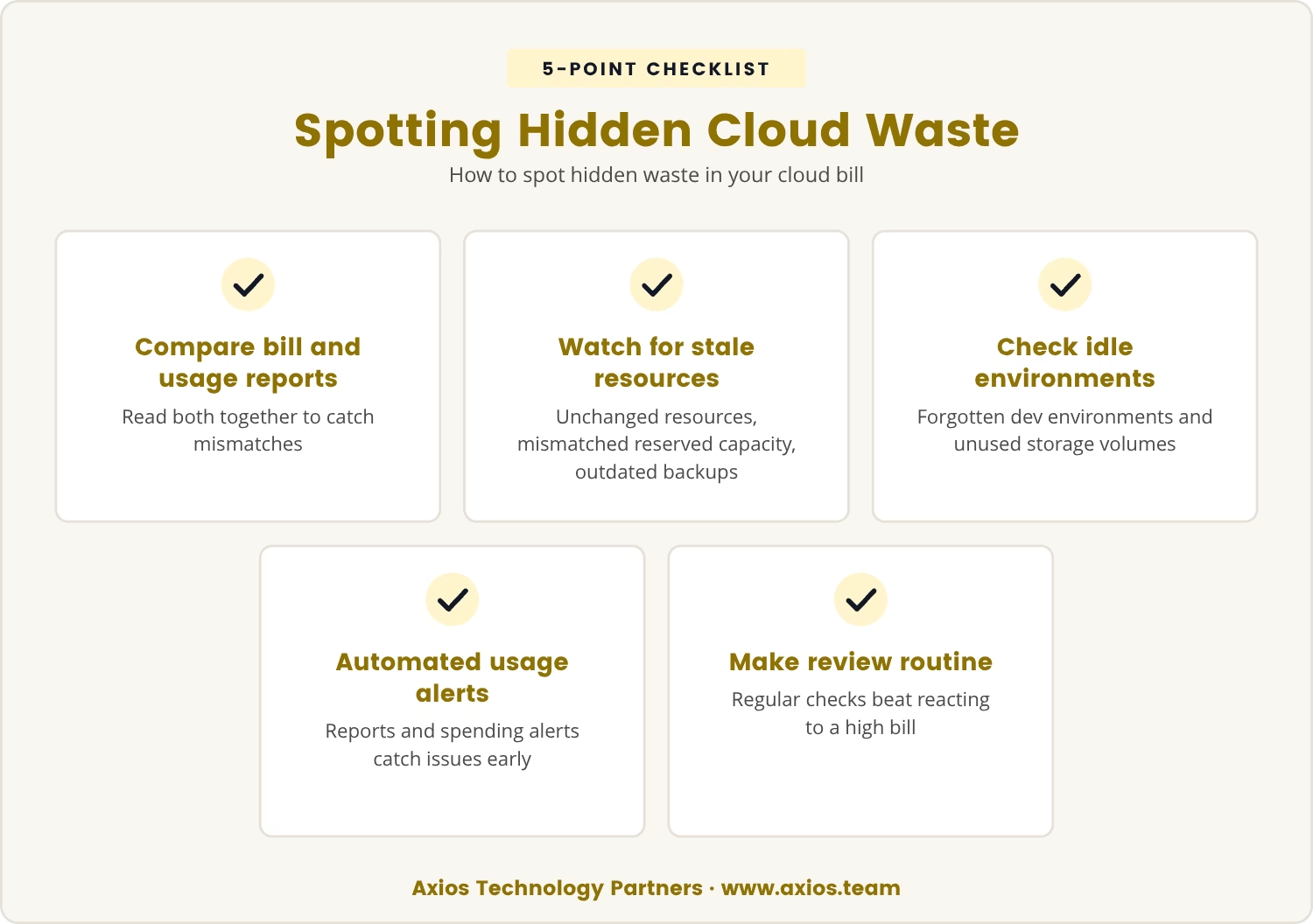
Spotting these drains starts with a careful read of the cloud bill and usage reports side by side. Look for resources that haven't changed in weeks, reserved capacity that no longer matches current needs, and backups older than the retention policy actually requires.
When was the last time anyone checked for idle development environments or unused storage volumes sitting in the account?
Most cloud management tools can generate automated reports flagging underused or forgotten resources, and pairing those with alerts for unusual spending spikes catches problems early rather than after the invoice arrives. The habit that matters most is making this review routine, not something triggered only by a shockingly high bill.
Cutting costs here doesn't require cutting corners; it requires targeting the specific drains already identified. The following steps address waste directly while keeping systems just as reliable:
Each step targets one specific source of waste, which means spend comes down without touching the team or the customer experience.
For businesses in Nashville, cloud usage keeps climbing as more teams move operations online, and that growth is exactly what raises the stakes on waste. New opportunity brings new exposure, and without a plan for ongoing cost optimization, expenses creep upward unnoticed.
Regular reviews paired with automated tools keep that creep in check. Focusing on the five recurring drains above keeps the cloud budget under control while still supporting the growth driving it.
Addressing these recurring sources of waste frees up budget that can go toward growth and innovation instead. None of it requires cutting performance or trimming the team - it just means removing what wasn't adding value in the first place.
Businesses that manage cloud spend well tend to see exactly the kind of outcome described earlier: higher profits and faster growth, achieved simply by making existing investments work harder. The difference was never the technology - it's the attention paid to how that technology gets used.

If your business has 40 to 100 users, you likely rely on cloud services but may not have time to review every line of your bill. At Axios Technology Partners, we see how easy it is for unnoticed waste to build up, even when everything seems to be running smoothly.
We invite you to see how our approach to ongoing cloud cost reviews can help you get more value from your existing cloud investments.
Get free ongoing security awareness training for your entire team—available to qualifying businesses ready to optimize their cloud spending.
Compare actual usage patterns against the pricing models a provider offers. Steady, predictable workloads tend to fit reserved or savings plans better, while variable usage often favors pay-as-you-go pricing, so reassess the fit whenever needs shift.
Track compute utilization closely and resize instances as workload or team size changes, using management tools to automate scaling where possible. Periodic reviews of the environment catch unused or oversized resources before they become permanent costs.
Yes - several third-party tools aggregate usage data from AWS, Azure, Google Cloud, and others into a single view. They typically provide dashboards, alerts, and recommendations that surface waste and optimization opportunities across every account at once.
Set alerts for spending thresholds and unusual activity, then back them up with regular reviews of the bill and usage reports. Automating cleanup of unused resources and setting clear provisioning and decommissioning guidelines closes most of the remaining gaps.
Cover resource provisioning, usage monitoring, backup retention, and scheduled cost reviews, with clear ownership assigned for managing expenses. Add explicit guidelines for scaling up or down, plus automated steps for cleanup and reservation optimization to keep spending predictable.