
Discover how to manage cloud cost effectively by identifying hidden drains that impact your budget.

November 25, 2026
A data breach is almost never a single event—it’s a process that starts before you notice and continues after you think it’s over. Businesses that treat response as a one-time task remain vulnerable to repeated and growing losses.
Imagine a Nashville retail shop discovers one Monday morning that customer payment data has been stolen. The owner assumes the worst is over once the stolen files are found—but what if that discovery is only the midpoint of the story, not the end?
A single incident can trigger a chain of problems, each one harder to spot than the last, because most data breaches are not isolated moments but complex processes that develop over time. That distinction matters more than it sounds: when a breach is treated as a moment rather than a process, businesses stop looking just as new damage is taking shape.
The stakes are high enough to justify the caution. The average cost of a data breach is $3.86 million, showing just how much can be at stake when these events are not handled as ongoing threats.
Understanding how breaches really happen, and why a one-time fix is never enough, can help you avoid repeat losses and mounting recovery costs.

Most people picture a breach as something that happens in an instant, but the process usually starts much more quietly than that. Attackers may spend weeks or even months inside your systems before you detect anything unusual.
The entry point is often mundane: a weak password guessed correctly, or a phishing email answered without a second thought. Once inside, the attacker doesn't rush. Instead, they move slowly, mapping your network and hunting for valuable data — a stretch of time security teams call "dwell time," the gap between first entry and eventual discovery.
During that gap, attackers collect credentials, escalate their access, and quietly siphon out sensitive information. By the time anything looks suspicious on the surface, the deeper damage is frequently already done.
So the breach is less a single event than a sequence that unfolds in stages, and each stage it passes through adds a new layer of risk and complication for the business behind it.
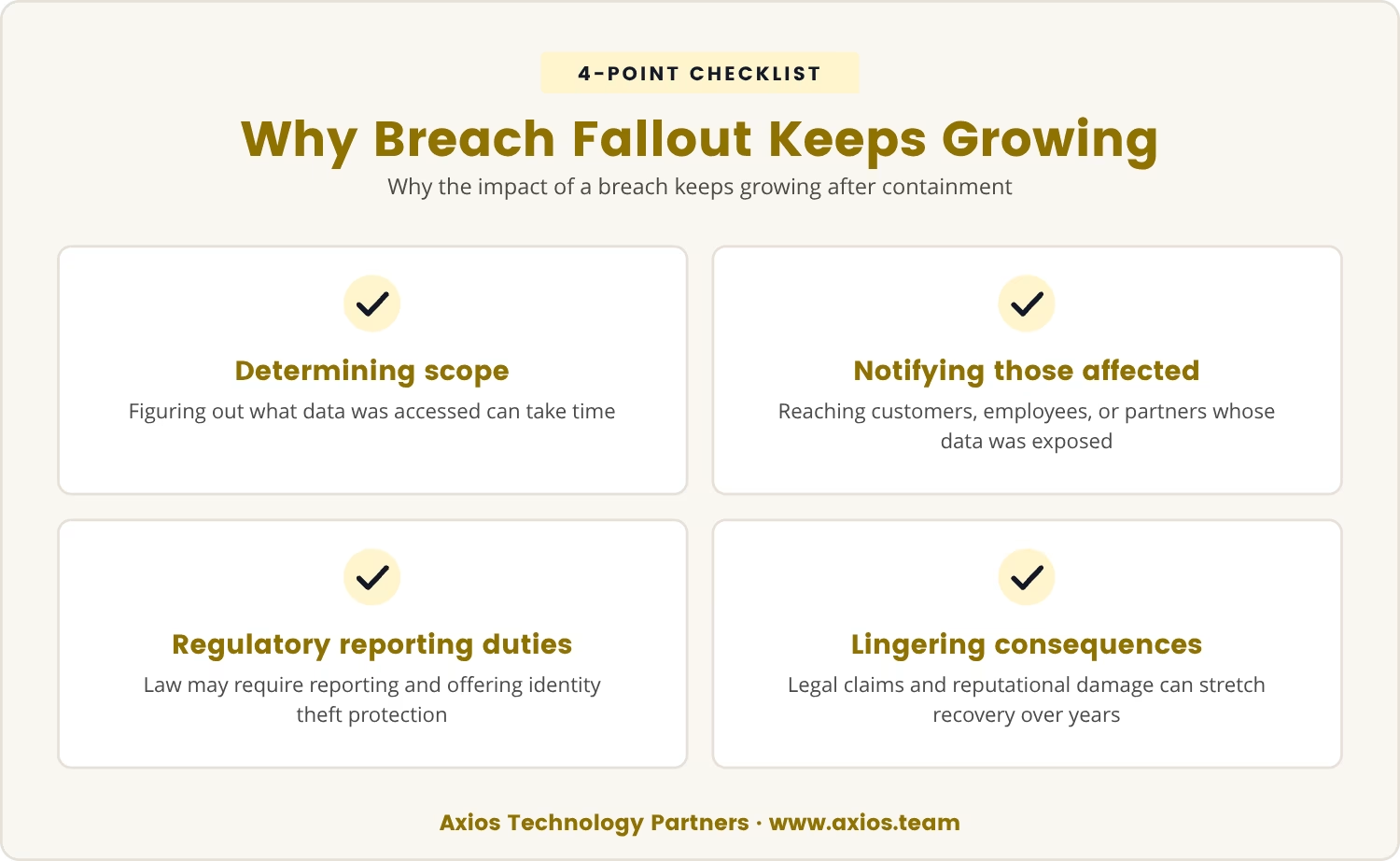
Stopping a breach is only the beginning, and what follows is a long list of challenges that containment alone does not solve.
The first challenge is scope: figuring out exactly what data was accessed or stolen, which can take time, especially if the attacker covered their tracks. Once that picture is clear, notification follows — reaching everyone whose personal information was exposed, whether customers, employees, or partners.
Regulatory requirements then add their own pressure on top of that. If social security numbers or other sensitive data were involved, the law may require reporting the incident and offering identity theft protection.
Even after those steps are checked off, consequences tend to linger. Legal claims, reputational damage, and the ongoing cost of rebuilding trust can all follow, stretching full recovery out over months or even years.
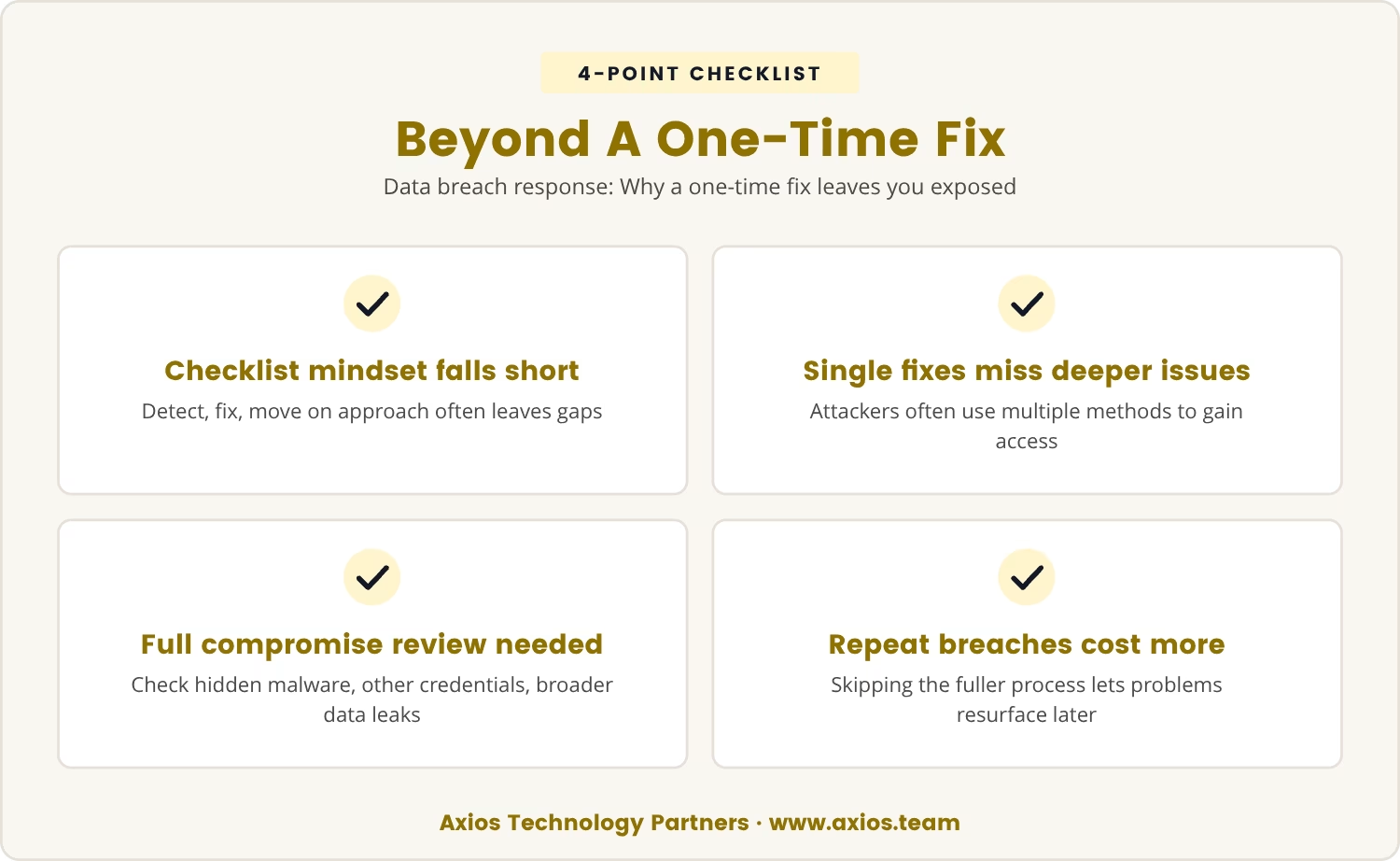
Many businesses in Nashville treat breach response as a checklist: detect the problem, fix it, move on. That approach, though, often leaves gaps that attackers can exploit a second time.
Addressing only the immediate cause — patching one software vulnerability, resetting one password — tends to miss deeper issues, since attackers often use multiple methods to gain access, and a single fix rarely closes every door they opened.
A true data breach response looks for every sign of compromise, not just the obvious one. That means reviewing systems for hidden malware, checking for other compromised credentials, and assessing whether a data leak occurred beyond what was first discovered.
Skipping that fuller process is what allows breaches to repeat. Without it, the same problems resurface later, usually at a higher cost than the first time around.
A data breach typically unfolds through several key stages, and recognizing each one makes it easier to spot problems earlier and respond effectively.
Attackers find a way in, often through phishing, weak passwords, or exploiting software flaws. This step is usually invisible to the business at first.
Once inside, the attacker explores the network, looking for valuable data and mapping out how systems connect.
From there, the attacker pushes for higher-level access, such as administrator rights, to reach more sensitive information.
With that access secured, sensitive data gets gathered, often including personal information, credentials, or business secrets.
The attacker then moves the data out of the network, sometimes in small amounts to avoid detection.
Finally, efforts are made to erase evidence of the breach, making it harder to understand what happened and how.
Each stage increases the risk to the business and makes recovery more complex than the one before it.
Not all breaches announce themselves. Some signs are easy to overlook, especially when attention is focused only on major incidents.
Spotting these early can mean the difference between a contained incident and one that escalates further.
Preventing a breach is not a one-time project but a practice that needs ongoing attention and regular updates.
Regular employee training, for instance, helps a team recognize phishing attempts and avoid common mistakes, while updating software and applying security patches close vulnerabilities before attackers can use them.
Monitoring for suspicious activity and reviewing access rights adds another layer, ensuring that only authorized users can reach sensitive information. Repeated consistently, these habits make it far harder for attackers to succeed.
If you haven't reviewed your breach prevention strategy in the last six months, what would you find if you looked closely at your current defenses?
Treating a breach as a single event tends to make businesses underestimate its true cost, since cleanup expenses often multiply as new problems surface over time.
A missed backdoor or an update skipped on one overlooked system can let attackers return, and each new incident adds to recovery costs while damaging reputation further.
That dynamic is part of what the average cost of a breach — $3.86 million — actually reflects: not just the immediate response, but the long-term impact on the business.
By treating breach prevention and response as ongoing responsibilities, a business reduces the risk of repeat incidents and keeps long-term costs under control.

Many businesses with 40 to 100 users find themselves reacting to breaches as isolated events, only to face new threats later. At Axios Technology Partners, we understand how easy it is to miss the ongoing risks that follow a single incident.
We invite you to see how our approach addresses breach response as a continuous process, not just a quick fix. Let’s talk about what that could look like for your own business.
Get free ongoing security awareness training for your entire team—available to qualifying businesses as part of our commitment to lasting protection.
Look for signs like continued suspicious activity, new unauthorized access attempts, or unexpected changes in your systems. If you are unsure, a professional security assessment can help confirm whether the threat is gone or if more action is needed.
First, contain the breach by isolating affected systems and changing compromised credentials. Then, investigate to understand what happened, notify anyone whose personal data was exposed, and review your security measures to prevent future incidents.
Even with strong defenses, human error, new vulnerabilities, or sophisticated attacks can still lead to a breach. Regular updates, employee training, and monitoring are needed to keep up with evolving threats.
A data leak usually involves the accidental or unauthorized exposure of information, while a breach often means an attacker intentionally gained access to your systems. Both can have serious consequences, but a breach typically involves more deliberate and targeted actions.
Breach prevention is about building regular habits — like updating software, training staff, and monitoring for threats — into daily operations. This approach helps catch problems early and reduces the risk of major incidents.