
Discover how to manage cloud cost effectively by identifying hidden drains that impact your budget.

November 25, 2026
The first warning sign of weak vendor management is not higher costs or missed targets, but a drop in internal team morale. Staff feel the strain early, absorbing extra work and stress long before any invoice or metric reveals the problem.
A vendor relationship typically runs through a handful of moving parts: a contract gets signed, deliverables get scheduled, and someone on staff is expected to catch whatever falls short. That last part is where the system usually gives way first, long before anyone checks the invoices or the service-level report.
A clear, standalone insight: the way vendors are managed shapes a staff's workload and morale before it ever touches the bottom line. A weak process announces itself through friction long before it shows up as a cost.
That's because vendor management was never just the task of picking suppliers and tracking what they deliver. It's the ongoing work of building relationships, setting expectations, and keeping everyone pointed at the same goals, and when that groundwork breaks, the cracks spread through the business in ways a spreadsheet won't capture right away.

Most leaders brace for vendor trouble to surface as missed deadlines or inflated invoices, yet the real cost usually starts closer to home. When a vendor misses the mark, it's staff who absorb the difference, redoing the work, chasing clarifications, patching the gap. None of that labor lands on a balance sheet, but it accumulates, and people feel the weight of it long before anyone else does.
Picture a vendor handing back a project that's half-finished: someone now has to spend hours repairing it or pushing the issue up the chain, and that time comes directly out of the hours meant for their actual job. The frustration compounds with each repeat, and so does a quieter cost - morale erodes a little further every time.
Once employees start to feel like their job is cleanup duty, burnout and turnover follow close behind. The strongest performers tend to leave first, and the ones who stay often disengage, which sets a cycle in motion that's nearly invisible until it's already done damage.
That cycle has a price tag, even if no one's tracking it: every fix your team makes to a vendor's mistake is a cost paid twice, once to the vendor and again in staff hours. Individually these costs look minor, but strung across weeks or months, they quietly drain budgets and slow down whatever project they touch.
The deeper loss is attention. Each hour spent wrestling with a vendor's shortfall is an hour pulled from strategic work, and that shift doesn't just dent productivity; it dents how people feel about their jobs. Most employees want to spend their time on work that matters, not on rework that was preventable.
In Nashville, where plenty of businesses lean on outside vendors for IT and other services, this hidden cost tends to bite harder. Local teams often feel pressure to keep operations smooth even when a vendor isn't holding up its end, and that pressure, left unaddressed, wears away at trust and teamwork from the inside.

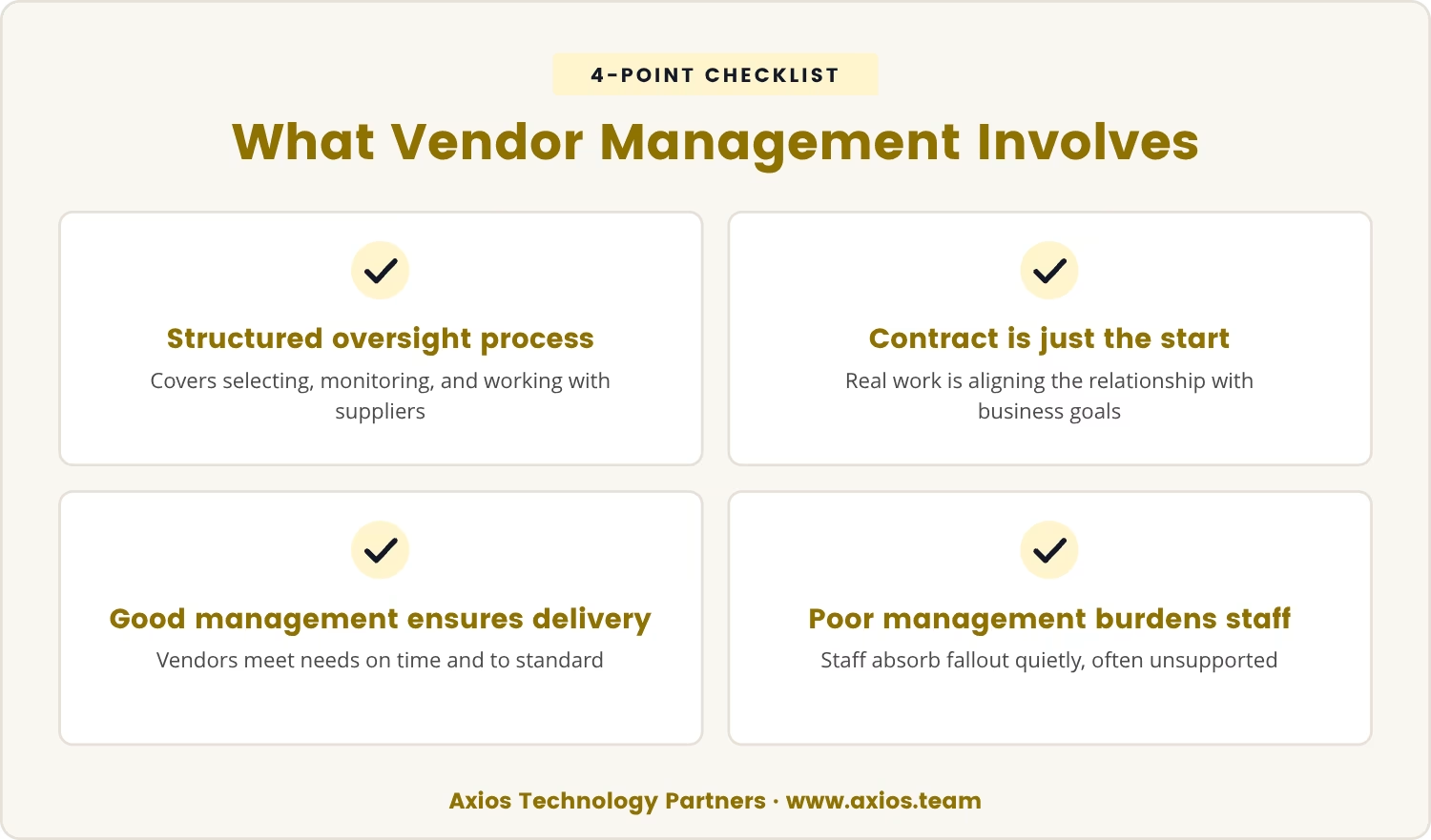
Given how much is riding on it, it's worth being precise about what vendor management actually is: the structured approach a business uses to select, monitor, and work with third-party suppliers, covering everything from choosing the right partner to measuring results and handling problems as they come up.
A solid vendor management process rests on clear expectations, steady communication, and a system for tracking outcomes. Signing a contract is only the starting point; the real work is building a relationship that keeps pulling in the same direction as the business's goals.
Done well, vendor management makes sure vendors deliver what's needed, on time, at the standard expected. Done poorly, it's the staff who absorb the fallout, usually without anyone noticing or offering support.
Given that gap between a good process and a weak one, the symptoms tend to show up in the team long before they show up in a report. Watch for these signs that morale is quietly taking the hit:
Individually, each sign looks minor, but together they build a toxic work environment and drive hidden costs higher.
Left unaddressed, those signs compound: when employees feel unsupported in dealing with vendors, motivation drops, and over time that erosion shows up as higher turnover, especially among the strongest performers. Replacing them, through recruiting, hiring, and training, can cost far more than whatever was saved by choosing a cheaper vendor in the first place.
The employees who stay don't necessarily stay productive. Some pull back from owning vendor-related projects, others simply stop reporting issues, and that silence makes it even harder to catch problems before they turn serious.
If complaints or resignations have ticked up following a vendor change, it's worth asking: are internal processes making it harder for the team to succeed?
Since so much of the damage traces back to process, the fix has to start there too - effective vendor management isn't just contracts and checklists, it's a system that shields staff from stress that doesn't need to exist. A few practices help build that system:
Spell out exactly what's needed from vendors, including timelines, deliverables, and quality standards. Share those expectations with the team so everyone's working from the same playbook.
Schedule regular check-ins with vendors and bring key team members into them. Open communication catches issues early and heads off misunderstandings before they calcify.
Use a vendor management system to monitor results and flag problems as they emerge. Share that performance data with the team so they know their concerns are actually being heard.
Give employees a clear path for raising vendor problems. Make sure they know raising a flag leads to action, not silence.
Ask the team directly what's working and what isn't. Adjust the vendor management process accordingly to cut friction and support staff well-being.
Acknowledge when employees go beyond their role to manage a vendor issue. Public recognition can offset some of the frustration and keep morale from slipping further.
These practices work best when backed by the right tools, since modern vendor management systems can automate much of the tracking and reporting that otherwise falls on staff. By centralizing information and streamlining communication, these systems cut down on the manual work a team would otherwise absorb by hand.
A good system also surfaces patterns that are easy to miss manually, like which vendors consistently cause trouble or which internal processes create bottlenecks. With that visibility, problems can be addressed before they ever reach morale or performance.
Investing in the right technology, then, isn't only about efficiency. It's about giving a team room to focus on real work instead of cleanup.
All of this points to one conclusion: when vendor management breaks down, staff feel it before the metrics do. Ignoring those early signals tends to invite bigger problems later - higher turnover, lower productivity, rising costs that are hard to trace back to where they started.
Paying attention to team morale isn't just sound leadership. It's a practical way to catch vendor issues early and keep hidden risks from taking root in the business.

Many businesses with 40 to 100 users find that vendor problems quietly drain their team’s energy and focus before they ever notice a billing issue. At Axios Technology Partners, we understand how frustrating it can be to see your staff picking up the slack for outside vendors.
If you’re ready to see how we approach vendor management to protect your team and keep morale high, let’s talk about your current setup.
Get free ongoing security awareness training for your entire team—an offer designed to support staff and reduce hidden risks as you strengthen your vendor management.
Look for repeated complaints about fixing vendor mistakes, frequent overtime, or project delays tied to vendor deliverables. If staff are spending more time correcting outside work than doing their own, the vendor management process needs attention.
Small teams benefit from clear roles, regular check-ins, and a simple way to track vendor performance. Management software can automate tasks and keep everyone informed even when resources are limited.
A strong vendor onboarding process sets the tone for the entire relationship. When vendors understand expectations and processes from day one, they're more likely to deliver consistent results and less likely to create friction for internal teams.
Supplier management typically focuses on the flow of goods and materials, while vendor management covers a broader range of services and relationships. Both require clear communication and performance tracking, but vendor management often involves more complex interactions and risk management.
Well-written contracts spell out responsibilities, timelines, and escalation paths. Making these details clear gives a team a reliable framework for handling issues quickly, which cuts down on stress and uncertainty when vendor problems arise.